Guandu
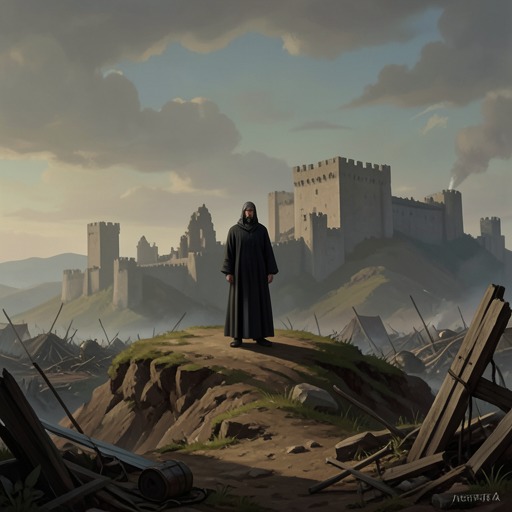
The Romance of the Three KingdomsGuandu is the site of the prolonged confrontation between Cao Cao and Yuan Shao that becomes a decisive test of their competing power. Yuan Shao brings a force vastly larger than Cao Cao’s, but the campaign’s outcome is shaped not by numbers alone: limited supplies, defensive ground, intelligence about grain transport, and the vulnerability of Yuan Shao’s provisions all make Guandu a contest of endurance and logistics as much as battle.
Setting and Strategic Stakes
Yuan Shao leads a huge army toward Guandu, while Cao Cao can muster only about one-tenth as many men. Cao Cao’s adviser Xun You urges him to attack promptly: his veterans may be able to face a much larger force, but their supplies are limited and cannot sustain a drawn-out campaign. Cao Cao advances, and the two leaders exchange accusations over who has the right to act in the name of the Han court. Their claims make the confrontation political as well as military, even as the practical question of how long each army can remain in the field becomes increasingly urgent.
The first clash goes against Cao Cao. His men retreat under a heavy shower of enemy arrows and return to camp outside Guandu. Yuan Shao moves his own camp to confront them, and a stalemate follows. Yuan Shao’s forces attempt to tunnel beneath Cao Cao’s camp, but Cao Cao’s soldiers frustrate the plan by digging a deep moat. The deadlock lasts month after month, and food supplies begin to run short on both sides.
Supply Lines and the Turning Point
A captured spy reveals that Yuan Shao expects a large grain convoy, led by Commander Han Meng. Cao Cao sends Xu Huang with a small elite force to attack it. The surprise succeeds: Han Meng flees, and the entire convoy is destroyed. The episode shifts attention from the size of the armies to the movement of provisions that sustains them. With both sides already short of food, the loss makes Yuan Shao’s supply arrangements a critical weakness.
Yuan Shao then becomes seriously concerned about Wuchao, his main supply base, and sends twenty thousand men under Chunyu Qiong to guard it. The account presents that appointment as dangerous: Chunyu Qiong’s drinking and rages have made him frightening to his own soldiers, and he arrives at Wuchao drunk. Guandu’s strategic significance thus extends beyond the camps facing one another: the confrontation depends on a wider network of grain routes and stores, and the security of that network is entrusted to a commander whose conduct raises doubts.
Victory, Reputation, and Wider Consequences
After the defeat, Yuan Shao escapes and his shattered forces regroup for the march back to Jizhou. On the way, he hears his men lamenting friends and relatives lost in battle; their grief troubles him even after he reaches safety. The scene gives the campaign a human consequence beyond the fortunes of its commanders, showing how the struggle reaches into the ranks and families of the defeated army.
The narrative also connects Cao Cao’s victory at Guandu with the expectations of local people. When Cao Cao later camps by a river, villagers tell him of an astrologer’s prediction that a worthy man would appear in the area fifty years after a yellow star was seen. They identify his defeat of Yuan Shao with the prophecy and welcome him as a benevolent ruler who might bring peace after suffering under Yuan Shao’s taxes. Moved by their account, Cao Cao orders that the villagers be protected and that anyone who steals from them be executed. Guandu’s legacy in the story therefore includes not only a military reversal but also a public interpretation of victory as a possible sign of just rule.
Guandu in the Novel’s Historical Landscape
The novel treats real events as the framework for an epic shaped by storytelling, drama, and literary composition. Guandu belongs to the historical struggle in which powerful leaders carve kingdoms from the weakening Han order, but its narrative force comes from making the contest legible through particular choices: Cao Cao’s willingness to attack despite inferior numbers, the defensive moat, the destruction of a grain convoy, and the danger surrounding Wuchao. In this account, military advantage is neither fixed nor reducible to troop strength; it can be changed by supply, deception, and the decisions made at vulnerable points in the campaign.